Tuesday, 6 November 2012

Monday, 5 November 2012
Case Study - Once Upon a Time in America - Part 2
How Leone Establishes Genre
Scene 1:
The non-diegetic sound of" God Bless America" being played over the titles and in to the first few shots which Leone could be using to portray an ironic or critical view of the state of America, especially because the femme fatale is murdered with this song in the background. This song is also used at the end of "The Deer Hunter" (1978) and also signifies the poor state of which America is in as it is sung by all of the remaining characters after they have lost practically everything, could this be a message as the directors of both of these films are Italian. Could they be possibly be mocking America? Along with this soundtrack there are also footsteps being heard (diegetic sound) which establishes a sense of suspense, as the audience know that a character is moving somewhere, but they cannot see where or who, this sound anticipates the next scene.
Leone uses chiaroscuro lighting (familiar with early noir thrillers) to show the dark nature of the thriller genre. Non-ambient lighting is used to full effect, creating a spotlight effect on the femme fatale character, showing that she is who the audience should be focusing on and also to highlight the fact that she is potentially a dangerous or vulnerable character. Although it is non-ambient it is done so well that it looks very natural or ambient, so the audience still get the feeling that it's a very real life situation which is what many thrillers use to create the fear and suspense. The tiffany lamp on the bedside table seems to blend with the skin tone of Eve, the lamp could be a visual metaphor for Eve herself representing the idea that she is an exquisite character but delicate at the same time.
The pearls that the femme fatale character is seen to be wearing could be used as a visual metaphor for tears, this gives the audience a sense of foreboding of what is about to happen (her immanent death) or perhaps some of the events that will happen later on in the film. Tears could represent different emotions, pain and suffering is the primary thought when a person is seen crying but the tears could also be attributed to happiness. In the thriller genre it is more likely to be the latter of the two as it is quite a dark genre. A very obvious prop that is seen early is the guns that the bent cops are using to threaten and kill the femme fatale (note that 'Eve' is not dangerous but vulnerable in this scene, appealing more to the weak and obidient depiction of women within film), this is a direct link to the thriller genre as guns are very often used in thriller films, especially because of the nature of violence and death. An example of the use of guns in the opening of a thriller would be in "Pulp Fiction" (1994) where the couple are seen in the cafe, robbing people of their wallets. Another prop or props that are used in this opening scene are the trilby's and overcoats worn by the cops, these are generic conventions for the thriller genre and are very often seen in the more classic thrillers as well as noir thrillers, usually featuring some sort of detective. The way that the bent cops are standing closely together and wearing similar attire suggests a bond, perhaps through work or maybe even on a personal level, and this bond is shown as strong by their presence amongst the mise en scene. These garments don't show the audience what the characters are wearing underneath, adding to the mystery of the character because the audience can't judge the characters nature from their initial appearance.
The low angle shot is used very often when the crooked cops are being shown, this is because this type of shot establishes a feeling of power, authority and their class amongst the other characters (that being higher due to the power they supposedly possess) therefore it allows the audience to immediately see who is in control and who the villains are. Close ups are also used frequently in the thriller genre, this is to portray the emotions that the characters are feeling with the help of facial expression and this helps to make the audience feel connected to the characters.
Scene 2:
There is a quick cut to the second scene, Leone has done this to ensure that the suspense is not lost and the action is still fresh in the mind of the audience. This scene is made up of mostly, if not all, diegetic sound which helps to ground the audience as there are no exterior distractions from the dialogue, it also shows an importance to what is being said in the conversation between the cops and the victim regarding the named 'Noodles' character.
In this scene the most dominant shot types is definitely the close up shot, this is because of all the emotions going on with the victim being beaten and his life being threatened. These shots engage the audience, drawing them in by forming an emotional connection and they also establish the characters. During the conversation between the two characters there is a lot of shot reverse shot, this helps the audience to keep up with who is saying what and also to help the audience feel as though they are taking part in the conversation themselves. This technique is used a lot when filming conversations and it is quite a standard way of doing so, many films make use of the technique whether they are thrillers or not.
One thing that was prominent to me was that one of the cops, the one who seemed to be in charge, was wearing a chunky gold ring with a bull on which could have symbolised several things, perhaps his standing amongst the other cops or his belonging to a club or society? Whatever it meant it certainly seemed to have been made quite obvious so it must hold some value regarding the type of character that the cop will eventually be shown as.
Scene 3/4:
Again chiaroscuro lighting is used to further establish the genre, with dimly lit spaces hiding some shady characters. The non-diegetic sound of a phone appears within the head of the main character, 'Noodles, and this acts as a sound-bridge to the next scene meaning that it carries on through into the adjacent scene. The phone sound also creates a sound of mystery as the audience aren't clear as to where the phone is or who is calling, alongside this feeling of mystery there is also a sense of irritation as the repetition of the noise eventually becomes unbearable until the audience are begging for the phone to be picked up, therefore intriguing the viewers to see who is making the call.
After the cut to the next scene the audience are taken outside into a rainy night, a typical setting for a thriller. The rain makes the streets gleam which symbolises the genre perfectly and bears similarities to noir films and the lighting used in the urban scenes. The use of the rain depicts a gloomy and cold atmosphere, adding to the overall feel of the film and the link that Leone is trying to make to the genre, and while doing so it also adds a sense of darkness to the mise en scene.
Sunday, 21 October 2012
Case Study - Once Upon a Time in America
Brief notes on the background of Once Upon a Time in America and the opening scene(s)
Background Facts:
Background Facts:
- Released in 1984
- Directed by Sergio Leone, a well known auteur director and famous for 'spaghetti westerns' such as "The Good, the Bad and the Ugly" and "Once Upon a Time in the West"
- Set in a period between the 1920's to the 1960's, the film is largely told through flashbacks from the 1960's.
- Heavily intwined with the Prohibition that took place in America from 1920 to 1933. Prohibition was the ban on the sale, manufacture and transportation of alcohol. During this period organised crime received a major boost due to bootlegging and the black market.
- The film is a literary adaptation of the book "The Hoods" by Harry Grey
- Harry Grey wrote about life in the twenties and thirties and the syndicates that controlled the businesses in New York. Wrote "Call Me Duke" and "Portrait of a Mobster" as well as "The Hoods'
- Shown at Cannes Film Festival
- 3 cuts were made; the original being 269 minutes long, the European cut is 229 minutes long and the USA cut is 139 minutes long; this version had the narrative changed by re-editing the scenes in chronological order.
- "Epic tale of a group of Jewish gangsters in New York, from childhood, through their glory years during prohibition, and their meeting again 35 years later" - Short summary from IMDB page
Notes on opening scene(s):
- Characters: right from the outset we see traditional characters that may be found in thriller films, especially the sub-genre, crime thrillers. These characters could possibly be gangsters/criminal or maybe even bent cops, it is hard to tell exactly from the 4 minutes viewed. What we can see is that these characters are most definitely shady and so fit the thriller genre perfectly as they would not look out of place in completing dark acts. Alongside these gangsters/criminals/bent cops we have the victims that they are terrorising/interrogating, these sort of characters often appear in the thriller genre because they help to convey the fear and emotion of what is happening. Victims are also used in thrillers because it helps to ground the audience, thrillers are based very much so on reality and the grittiness of what can actually happen in life and so the victims remind the audience that what is happening in the film (sometimes) happens in real life also. Lastly it appears that a 'femme fatale' is present in the opening, she must be dangerous/deviant because the gangsters give no thought in shooting her after she denies knowing the location of the man in question, the fact that they shoot her hints that she may know some information that is potentially dangerous.
- Locations/settings: The locations used in the opening scenes are dimly lit, or what could also be referred to as 'noir lighting'. This helps to convey the dark mood/nature of the thriller genre and also that of the film, giving us a sense of foreboding of what is to come.
- One of the first props used in the opening are guns, this seems appropriate to the gangster feel of the film as guns are a method of quick and easy death, death is frequently apparent in the thriller genre because it is almost inescapable when dipping into the darker side of the genre.
- The opening scenes leave the audience with a lot of open questions and uncertainty, for example who is the man that the gangsters are looking for? Why are they looking for him? Who are the people being interrogated and what do they know? The aim of proposing all of these questions is to ensure that the audience will be hooked into the film, to make sure they don't get bored and Once Upon a Time in America does this well.
Why might the femme fatale be considered a misogynist representation of gender?
I don't think that the femme fatale is a misogynist, more the complete opposite because they are often portrayed as dangerous, deviant, mysterious and sometimes 'fatal'. This is quite contradictory to the traditional misogyny towards women because they can often be shown as weak or unable to do things for themselves; women are also objectified in many films as promiscuous and untrustworthy. Femme fatale are often very different to this stereotype because they can be dangerous, sometimes more so than any of the male characters, and are very able to take action themselves. Although femme fatale's are seen as being more confident within roles they are still almost always depicted to be seductive, which they often use to lure men into dangerous situations. This could be seen as a misogynistic towards the female gender because it gives the impression that all women have to seduce men in able to co-operate with them which shouldn't be the case in real life.
Definition of Film Noir
The term 'Film Noir' comes from the French and means 'black film'. It's a genre that came about in the early 1940's and thrived predominantly in this era, with many classic noir thrillers being released around the time. There are several characteristics that can identify a 'noir' film; these are the characters/protagonists, the setting, the plot and visual style.
Characters


I don't think that the femme fatale is a misogynist, more the complete opposite because they are often portrayed as dangerous, deviant, mysterious and sometimes 'fatal'. This is quite contradictory to the traditional misogyny towards women because they can often be shown as weak or unable to do things for themselves; women are also objectified in many films as promiscuous and untrustworthy. Femme fatale are often very different to this stereotype because they can be dangerous, sometimes more so than any of the male characters, and are very able to take action themselves. Although femme fatale's are seen as being more confident within roles they are still almost always depicted to be seductive, which they often use to lure men into dangerous situations. This could be seen as a misogynistic towards the female gender because it gives the impression that all women have to seduce men in able to co-operate with them which shouldn't be the case in real life.
 |
| Anne Savage - Detour, 1945 |
Definition of Film Noir
The term 'Film Noir' comes from the French and means 'black film'. It's a genre that came about in the early 1940's and thrived predominantly in this era, with many classic noir thrillers being released around the time. There are several characteristics that can identify a 'noir' film; these are the characters/protagonists, the setting, the plot and visual style.
Characters
- Femme fatale (e.g Marion Crane - Psycho, Gilda).
- Private Eye
- Often alienated or bitter towards the world.
- Corrupt policemen.
- Jealous husbands.
- Gangsters
- Down-and-out writers.
- Cigarette smokers often symbolised the protagonists.
Setting
- Often shared with gangster film, police procedural, gothic romance and social problem films.
- Typical locations are Prohibition period cities such as Los Angeles, San Francisco and New York.
- Bars, clubs and gambling dens.
- Climax often takes place in industrial settings such as factories, refineries, power plants (conclusion of White Heat).

Plot
- Crime, often murder plays a part in the noir genre due to its dark nature.
- Greed and jealousy.
- Heists or con games.
- Murder conspiracies involving love affairs.
- Betrayals, false accusations and double-crosses.
Visual Style
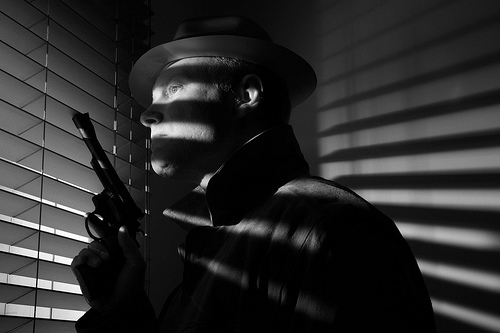
- Dark/low-key lighting contrasting with lighter areas, often creating interesting, striking shadow patterns. This can sometimes be called Chiaroscuro lighting, a term derived from Renaissance paintings which literally means "light-dark".
- Faces of characters are often partially or fully concealed by the shadows, appealing to the dark nature of the genre.
- Wide angle, low angle and tilt shots have known to be used frequently, this is mainly to disorientate the audience.
- Shots of characters distorted reflections also create a sense of disorientation amongst the audience.
- Often shot at night.
Friday, 19 October 2012
Preliminary Task - Evaluation
1. What Planning did you do? How was this useful, and how did you change from your plans?
As a group, we all contributed in discussing each aspect of the actual filming of the preliminary task, offering ideas and possibilities in able to gather together enough concepts to have quite a few different options if needed. We talked about the locations, types of shots and where each shot would be best used, suitable topics for conversations and who would be best doing what. After the rough planning we each created a storyboard, this allowed us to be familiar with what was going to take place and also to be able to visualize each little bit of the filming. I drew up my storyboards based on the discussions we had as a group, for example using an over the shoulder tracking shot at the beginning to establish what was going on and also to let the audience see a bit of the location.
This planning proved to be very useful because it consisted of a bit of everyone's views/opinions and ideas therefore each decision was met with fair constructive criticism or an agreement. Using the rough plan to begin with allowed me to quickly think of different themes for the conversation that would be appropriate for the time given (2 minutes) and also what kind of shots could be included in which locations. The brainstorming was useful for gathering ideas but as a group we had to make decisions, so we came up with a shot list that consisted of which shots would be used in which locations, this was useful because everyone then knew which shots we would be filming. Having the shot list also backed up the storyboards as it helped to cement the directions shown. An example of this would be that we had planned to use over the shoulder shots in the conversation, whilst using shot reverse shot to give the audience a sense that they are part of the interaction.

2. What camera skills have you developed? How confident are you with cameras, and has this confidence changed during the project?
To start with I just had a play around, filming from different angles to see what looked good, what was harder to shoot etc. This helped me to gain a small bit of confidence as I learned how the camera worked, which buttons did what and the capabilities that could be achieved, therefore I had a basic understanding/knowledge of the camera and shots which I could begin to build on throughout the project. I have had previous experiences with cameras and have dabbled into film with my own camera (Canon 550D), I also take photography so this gives me a good understanding of cameras in general and shot types. I think this previous experience helped me to feel more comfortable when using the camera and a good idea of what might look good, in a sense this gave me confidence because I could sort of guess which shot types would be really effective in which locations. Even with this prior knowledge/confidence I definitely think it grew as the project went on as I was using the camera more, practicing different shots and executing them effectively meant that I knew what could be used again in similar situations to achieve different emotions conveyed through the shot type.
As I was taking part in the conversation I couldn't film any of the scene, but I did help in deciding which shots to use. In contrary to this, I filmed most of the walking scenes, where Anna started from the squash courts and made her way the media editing suite. I feel that I did this part of the task well, I used a wide range of shots (over the shoulder tracking shot, long panning shot, close ups, medium close ups, tilt shot, birds eye view and low angle shot) to show Anna's journey. I thought the over the shoulder tracking shot at the beginning was particularly effective as it made the audience feel as though they were there, following Anna from behind. Another shot I felt was particularly convincing was the close up of the door handle being opened as it conveyed the action well and focused the audience's attention on what was happening. Both of these shots worked well with match on action as they linked fluidly with the next shots, making it seem as though there was no break in the filming.


Due to not having a chance to film the conversation I think that this is an area that I lack confidence in, purely because I'm not exactly sure what I would/should have done to shoot the conversation. This could easily be changed by filming a conversation setting and playing around with different angles and shots to see how to construct a well-shot interaction between two people.
3. What editing skills have you developed? How confident are you with using the editing program?
I have had no previous experience with editing video; I have used Adobe Photoshop which is a similar layout to the Adobe Premiere software that was used so it wasn't a completely foreign program to use to begin with. To start with the software looked pretty complicated with a lot of different buttons and features but it didn't take long to figure out what did what with a little assistance from a teacher. After this it became quite clear how to do different things with the raw video and software and my confidence grew with time.
I started to develop some techniques such as creating in and out points on video clips so to cut out unneeded footage or mistakes, this was very important as it made the continuity of the overall film a lot more credible and removed any blemishes that would effect the mood of the film. Learning this skill also meant that the match on action throughout the film was greatly improved; therefore it felt that the film was continuous and flowed well without any harsh cuts between action. Using the timeline was a big help as it allowed me to see how the footage was laid out visually and it helped to view bits that may have needed smoothing over or cutting out, this was achieved because the timeline allowed me to have a reasonable amount of accuracy when skipping over and viewing the clips. Along with cutting footage, we also learned how to use some transitions, such as fade to black and cross fade, in order to smooth over some of the cuts in between some of clips. Even though I had never used this software before, I am now confident enough to complete the basics and I feel confident that I would be able to do the editing by myself.
Other Comments
I feel that as a group we worked efficiently in pretty much every aspect of the task, coming up with solutions quickly and effectively ensured that we were always working on something. Although we didn't all previously know each other we all worked well together, contributing different skills to the task in hand. We quickly organised which responsibilities would belong to who but throughout the project we all helped a bit with each others roles within the group in order to make sure the responsibility was being handled properly and productively. We had to be careful when using the 180 degree rule because it could easily be crossed, leaving the audience disorientated. It is important not to break the 180 degree rule because it gives the audience a left right perspective and allows them to keep in touch with what is going on in the mise en scene. To avoid breaking the rule we made sure that all of the conversation was filmed on one side and the over the shoulder shots were on the correct side also.
As a group, we all contributed in discussing each aspect of the actual filming of the preliminary task, offering ideas and possibilities in able to gather together enough concepts to have quite a few different options if needed. We talked about the locations, types of shots and where each shot would be best used, suitable topics for conversations and who would be best doing what. After the rough planning we each created a storyboard, this allowed us to be familiar with what was going to take place and also to be able to visualize each little bit of the filming. I drew up my storyboards based on the discussions we had as a group, for example using an over the shoulder tracking shot at the beginning to establish what was going on and also to let the audience see a bit of the location.
This planning proved to be very useful because it consisted of a bit of everyone's views/opinions and ideas therefore each decision was met with fair constructive criticism or an agreement. Using the rough plan to begin with allowed me to quickly think of different themes for the conversation that would be appropriate for the time given (2 minutes) and also what kind of shots could be included in which locations. The brainstorming was useful for gathering ideas but as a group we had to make decisions, so we came up with a shot list that consisted of which shots would be used in which locations, this was useful because everyone then knew which shots we would be filming. Having the shot list also backed up the storyboards as it helped to cement the directions shown. An example of this would be that we had planned to use over the shoulder shots in the conversation, whilst using shot reverse shot to give the audience a sense that they are part of the interaction.

A screenshot from the final cut, showing the shot reverse shot that was initially planned on storyboards.
We changed from the plans slightly, this is because not everything can go perfectly to plan and there has to be some room for change. We had originally planned to have the conversation between myself and Anna where I would be a teacher and Anna a student, Anna would come to me and tell me she wanted to drop media. We had planned to do this in a pod in the study hall. This would not have worked for two reasons; It would not be believable for me to pose as a teacher as I am not old enough or convincing enough and if we were to have the conversation in a pod there would be too much background noise, also it would contradict the filming of the walking to get there. This meant we had to change the location of where the conversation would take place and what the conversation was about. We decided to stick with the idea of dropping media but I would simply play a friend of Anna's, informing her that she had missed the deadline, the location was changed to an editing room in media, this made it a more realistic setting whilst at the same time quieter therefore the conversation could be heard more clearly. We also added in an extra shot in which Anna is seen walking over the camera on the floor and then cut to show her walking away, this was added to ensure shot variety.2. What camera skills have you developed? How confident are you with cameras, and has this confidence changed during the project?
To start with I just had a play around, filming from different angles to see what looked good, what was harder to shoot etc. This helped me to gain a small bit of confidence as I learned how the camera worked, which buttons did what and the capabilities that could be achieved, therefore I had a basic understanding/knowledge of the camera and shots which I could begin to build on throughout the project. I have had previous experiences with cameras and have dabbled into film with my own camera (Canon 550D), I also take photography so this gives me a good understanding of cameras in general and shot types. I think this previous experience helped me to feel more comfortable when using the camera and a good idea of what might look good, in a sense this gave me confidence because I could sort of guess which shot types would be really effective in which locations. Even with this prior knowledge/confidence I definitely think it grew as the project went on as I was using the camera more, practicing different shots and executing them effectively meant that I knew what could be used again in similar situations to achieve different emotions conveyed through the shot type.
As I was taking part in the conversation I couldn't film any of the scene, but I did help in deciding which shots to use. In contrary to this, I filmed most of the walking scenes, where Anna started from the squash courts and made her way the media editing suite. I feel that I did this part of the task well, I used a wide range of shots (over the shoulder tracking shot, long panning shot, close ups, medium close ups, tilt shot, birds eye view and low angle shot) to show Anna's journey. I thought the over the shoulder tracking shot at the beginning was particularly effective as it made the audience feel as though they were there, following Anna from behind. Another shot I felt was particularly convincing was the close up of the door handle being opened as it conveyed the action well and focused the audience's attention on what was happening. Both of these shots worked well with match on action as they linked fluidly with the next shots, making it seem as though there was no break in the filming.

The over the shoulder tracking shot in the beginning of the final cut. This shot, as I mentioned earlier, was particularly effective because it gives a feeling as though the audience are closely following the character as she makes her journey towards the destination.

This is the close up shot of the door handle from the final cut, it creates an anticipation of what is about to happen when the character enters the room, especially as the audience cannot actually see what is in the room.
3. What editing skills have you developed? How confident are you with using the editing program?
I have had no previous experience with editing video; I have used Adobe Photoshop which is a similar layout to the Adobe Premiere software that was used so it wasn't a completely foreign program to use to begin with. To start with the software looked pretty complicated with a lot of different buttons and features but it didn't take long to figure out what did what with a little assistance from a teacher. After this it became quite clear how to do different things with the raw video and software and my confidence grew with time.
I started to develop some techniques such as creating in and out points on video clips so to cut out unneeded footage or mistakes, this was very important as it made the continuity of the overall film a lot more credible and removed any blemishes that would effect the mood of the film. Learning this skill also meant that the match on action throughout the film was greatly improved; therefore it felt that the film was continuous and flowed well without any harsh cuts between action. Using the timeline was a big help as it allowed me to see how the footage was laid out visually and it helped to view bits that may have needed smoothing over or cutting out, this was achieved because the timeline allowed me to have a reasonable amount of accuracy when skipping over and viewing the clips. Along with cutting footage, we also learned how to use some transitions, such as fade to black and cross fade, in order to smooth over some of the cuts in between some of clips. Even though I had never used this software before, I am now confident enough to complete the basics and I feel confident that I would be able to do the editing by myself.
Other Comments
I feel that as a group we worked efficiently in pretty much every aspect of the task, coming up with solutions quickly and effectively ensured that we were always working on something. Although we didn't all previously know each other we all worked well together, contributing different skills to the task in hand. We quickly organised which responsibilities would belong to who but throughout the project we all helped a bit with each others roles within the group in order to make sure the responsibility was being handled properly and productively. We had to be careful when using the 180 degree rule because it could easily be crossed, leaving the audience disorientated. It is important not to break the 180 degree rule because it gives the audience a left right perspective and allows them to keep in touch with what is going on in the mise en scene. To avoid breaking the rule we made sure that all of the conversation was filmed on one side and the over the shoulder shots were on the correct side also.
Saturday, 6 October 2012
Subscribe to:
Posts (Atom)